General
“Permission Cannot Be Used to Suppress Fundamental Rights”: Retired Justice Ferdino Rebello Questions Denial of Protest Permission on Azad Maidan

PANAJI: Retired Justice Ferdino Rebello, who is leading the ‘Enough Is Enough’ movement in Goa, has strongly questioned the denial of permission to Amreen Shaikh to hold a peaceful protest, raising concerns over the alleged suppression of citizens’ fundamental rights to freedom of speech and expression and peaceful assembly.
Rebello questioned the basis on which the District Magistrate could anticipate a threat to public tranquillity or a possible riot or affray in the absence of specific material to support such apprehensions. He argued that any order restricting a public gathering must be backed by relevant material and cannot be issued merely on the assumption that a peaceful assembly could disturb public order.
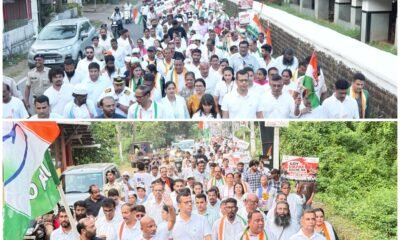
“What is the material before the Magistrate to say that a peaceful assembly will result in affecting public tranquillity?” Rebello asked, pointing out that people had been holding protests peacefully.
He emphasised that the right to assemble peacefully and express one’s views is guaranteed under the Constitution of India, subject to reasonable restrictions prescribed by law. However, he questioned whether citizens are legally required to obtain permission from the District Magistrate to hold a meeting or peaceful protest, asking the state government to clarify the legal provision under which such permission is mandatory.
“There is no such law,” Rebello asserted, challenging the authorities to identify the legal basis for requiring citizens or groups to seek prior permission to exercise their right to peaceful assembly.
Referring to the constitutional framework, he stressed that restrictions on the freedom of speech and expression and the right to assemble must satisfy the applicable legal and constitutional requirements. He questioned whether the denial of permission to Shaikh was supported by concrete grounds relating to public order.
Rebello also drew a comparison between the present situation and the Emergency imposed during the tenure of former Prime Minister Indira Gandhi. While describing the current situation as an “unofficial emergency”, he alleged that governments at both the state and national levels were increasingly seeking to curtail citizens’ constitutional rights.
Expressing concern over the role of institutions in safeguarding fundamental freedoms, Rebello recalled that during the Emergency, High Courts across the country had played an important role in addressing issues involving the protection of constitutional rights. He said citizens must remain vigilant and assert their democratic rights whenever they face attempts to restrict them.
The retired judge further cited the experiences of the ‘Enough Is Enough’ movement, alleging that permissions granted for public gatherings had subsequently been revoked on what he described as flimsy grounds. He questioned Chief Minister Pramod Sawant, who also holds the Home portfolio, and other senior government officials over the legal justification for such restrictions.
Rebello also linked the issue to the wider debate over the conduct of the Chief Election Commissioner and demands for his resignation. He referred to allegations of misuse of constitutional powers and concerns over the exclusion of voters from electoral rolls, arguing that citizens must retain the right to question public authorities and demand accountability through peaceful democratic means.
Responding to concerns that protests could lead to anarchy, Rebello questioned what constituted anarchy when citizens sought to exercise their fundamental rights, approach the courts or peacefully express their opposition to the actions of public officials.
He maintained that the right to protest cannot be taken away merely because citizens are questioning those in power. While acknowledging that peaceful assemblies remain subject to lawful and reasonable restrictions, he argued that authorities must establish valid grounds before imposing such restrictions.
Calling upon political parties and citizens in Goa to respond to what he described as an attack on democratic freedoms, Rebello said fundamental rights are guaranteed by the Constitution and do not depend on the goodwill of any ruling government.
“We suffered once. We cannot allow this Constitution to be trampled upon once again, indirectly,” he said, urging people to remain watchful and defend their democratic rights.
The controversy surrounding the denial of permission to Shaikh has brought renewed attention to the balance between the powers of district authorities to maintain public order and the constitutional right of citizens to organise peaceful protests. The legal justification for the specific order remains central to the questions raised by Rebello.